> ## Documentation Index
> Fetch the complete documentation index at: https://docs.duraton.ai/llms.txt
> Use this file to discover all available pages before exploring further.
# Events API
> Trigger workflows by sending an event, and read the durable event log.
An event is how you start a workflow from outside Duraton. `POST /events` ingests one event; Duraton matches it against every workflow [trigger](/core/triggers) in the project and
returns what it started. Every ingested event is also kept in a durable
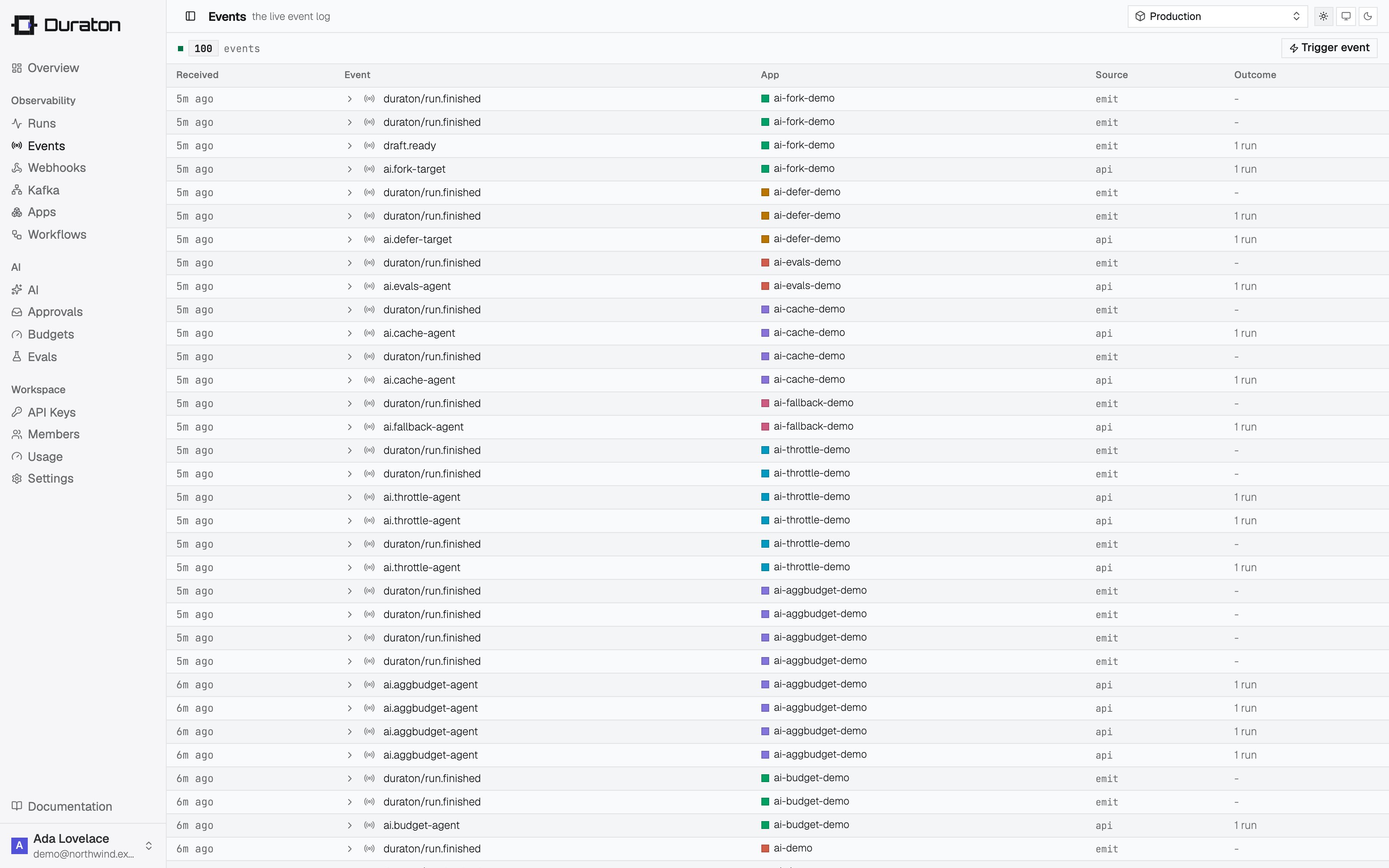
[event log](/core/workflows) you can read and tail.
 ## Send an event
```ts theme={null}
import { createClient } from "@duraton/sdk/client";
const duraton = createClient({ url: process.env.DURATON_URL! });
const res = await duraton.events.send({
name: "ticket.created",
app: "support-app",
data: { ticketId: "T-421" },
});
```
```sh theme={null}
curl -X POST $DURATON_URL/events \
-d '{"name":"ticket.created","app":"support-app","data":{"ticketId":"T-421"}}'
```
### Request body
| Field | Type | Meaning |
| ----------- | ------------------------ | ------------------------------------------------------------------------------------------------------------------------------------------------------------------------ |
| `name` | string, **required** | The event name workflows [trigger](/core/triggers) on. Non-blank, up to 256 characters. |
| `app` | string | Scope the event to one app's triggers. Omit to broadcast project-wide. |
| `data` | any JSON | The event payload, delivered as `ctx.event.data`. Any valid JSON - object, array, or scalar. |
| `dedupeId` | string | Drop a repeat of the same id (per app) within 24 hours, before any fan-out. |
| `runner` | string | Pin runs started by this event to a specific runner. |
| `targetApp` | string | Route a cross-app trigger to a specific app. |
| `session` | string | Thread the runs this event starts into one conversation, read back by [`GET /sessions`](/reference/api/runs#ai-spend-&-sessions). Omitted, each run is its own session. |
| `tags` | object of string->string | Customer-defined key/value metadata attached to every run this event triggers, for filtering runs by your own dimensions (see [Run tags](/reference/api/runs#run-tags)). |
`app`, `runner`, `targetApp`, `dedupeId`, and `session` are each bounded at 256 characters; a longer
value, a blank `name`, or unparseable `data` returns `400`. `tags` is bounded too: at most 20 tags per
run, each key up to 64 characters matching `[A-Za-z0-9_.-]` and each value up to 256 characters - an
over-limit tag returns `400`.
`tags` on an event is sendable from the TypeScript SDK - `SendEventInput` carries a `tags` field -
as well as over REST. The tags attach to every run the event triggers; filter those runs back with
`tag.` (see [Run tags](/reference/api/runs#run-tags)).
### Unsupported characters
An event must not carry a NUL character (`\u0000`). Duraton's durable event log has no
representation for it, so an event carrying one could never be stored. Duraton rejects it at ingest
with a `400` - before any workflow is matched or any run is started - rather than accepting the event
and failing later.
The check covers every text field (`name`, `app`, `runner`, `dedupeId`, `targetApp`, `session`) and
the whole `data` payload, at any depth: a NUL inside a nested string, an array element, or even a
JSON object key is rejected.
```sh theme={null}
curl -X POST $DURATON_URL/events \
-d '{"name":"ticket.created","app":"support-app","data":{"note":"bad\u0000byte"}}'
# 400
```
Only the escaped form `\u0000` reaches this check - a raw NUL byte in the request body is already
invalid JSON and is rejected as a malformed body. Either way the event is refused with a `400`, and
nothing is recorded.
### Response
`202 Accepted`. The body reports what the event did:
```json theme={null}
{
"runId": "01HXYZ...",
"woke": 0,
"triggered": [
{ "workflow": "fulfillment", "runId": "01H..." },
{ "workflow": "audit", "runId": "01H..." }
]
}
```
| Field | Meaning |
| ----------------------------------------------------------- | ------------------------------------------------------------------------------------------------------------------------------------------- |
| `runId` | The run started, when exactly one workflow matched. |
| `woke` | How many waiting runs this event resumed (via `step.waitForEvent`). |
| `triggered` | One entry per matched workflow: its `workflow` name, the `app` the run landed in (set even for cross-app fan-out), and the `runId` started. |
| `skipped` / `dropped` / `debounced` / `batched` / `deduped` | Flow-control outcomes - set when the event was held back rather than run immediately (see [flow control](/core/flow-control)). |
| `suspended` | `true` when the project is suspended: in-flight waiters were still woken, but no new run was started. |
An event that matches nothing still returns `202` with an empty `triggered` - it is recorded, not lost.
Each `triggered` entry's `runId` resolves to a run, and that run records the event back: its
`eventId` is this event's `id` (see [runs](/reference/api/runs)). List every run one event fanned out
with `GET /runs?eventId=`. Cron, child (`step.runWorkflow`), and on-failure runs carry no
`eventId` - they have no triggering event.
## Two kinds of deduplication
Two independent mechanisms can each report `deduped: true`, and they mean different things. Knowing which
one fired matters, because one throws the event away and the other only suppresses a single run.
| | Event `dedupeId` | Workflow [`idempotency`](/core/flow-control#idempotency) |
| ---------------------------------------------- | --------------------------------------------------------------------- | --------------------------------------------------------------------------------------------- |
| Set where | On the event (`dedupeId` on `POST /events`) | On the workflow definition (`idempotency: { key, periodMs }`) |
| Keyed by | The literal `dedupeId` string you send, scoped **per app** | A **field path** into the event `data` (e.g. `key: "ticketId"`), scoped **per workflow** |
| Window | Fixed **24 hours** | The configured `periodMs` |
| What is dropped | The **whole event**, before any fan-out | One **run** of that one workflow |
| Waiters woken? | No - a duplicate is dropped before `waitForEvent` waiters are checked | Yes - waiters are woken before the per-workflow gate runs |
| Recorded in the [event log](#reading-the-log)? | No - a duplicate is never persisted | Yes - the event is recorded, only the run is suppressed |
| Where `deduped` appears | At the top level (`{ "deduped": true }`, no `runId`, no `triggered`) | On that workflow's `triggered[]` entry (mirrored to the top level when it is the first match) |
In short: **`dedupeId` is event-level and total** - the exact same event is collapsed to a no-op, nothing
is recorded, and nothing is woken. It is the safety net for an at-least-once caller retrying `POST /events`.
**`idempotency` is run-level and partial** - the event still lands, still wakes waiters, and still runs
every *other* matching workflow; only a second run of the idempotent workflow for the same derived key is
suppressed within the window.
Because both surface `deduped: true`, tell them apart by the rest of the response: an event-level drop
returns no `triggered` array and no `runId`, whereas an idempotency drop still carries the event's
`triggered` fan-out with `deduped` set on the affected entry.
## Reading the log
The log records every event with what it did, newest first.
```sh theme={null}
curl "$DURATON_URL/events?app=support-app&name=ticket.created&limit=20"
```
| Method + path | Returns |
| -------------------- | -------------------------------------------------------------------------------------------------------------------- |
| `GET /events` | A page of event records. Filter with `?app=` and `?name=`; `?limit=` sets the page size (`100` default, `1000` max). |
| `GET /events/{id}` | One event record. |
| `GET /events/stream` | A live tail of incoming events (Server-Sent Events). |
Each record carries the event (`name`, `app`, `data`), its `source` (`api` for an external `POST`,
`emit` for a workflow's `step.emit`), when it arrived, and the `triggered` fan-out:
```json theme={null}
{
"id": "9f2b...",
"name": "ticket.created",
"app": "support-app",
"source": "api",
"data": { "ticketId": "T-421" },
"receivedAt": "2026-06-15T09:00:00Z",
"woke": 0,
"triggered": [{ "workflow": "fulfillment", "runId": "01H..." }]
}
```
The stream is a best-effort live view - a slow or reconnecting client can miss events. `GET /events`
is the complete record.
## Send an event
```ts theme={null}
import { createClient } from "@duraton/sdk/client";
const duraton = createClient({ url: process.env.DURATON_URL! });
const res = await duraton.events.send({
name: "ticket.created",
app: "support-app",
data: { ticketId: "T-421" },
});
```
```sh theme={null}
curl -X POST $DURATON_URL/events \
-d '{"name":"ticket.created","app":"support-app","data":{"ticketId":"T-421"}}'
```
### Request body
| Field | Type | Meaning |
| ----------- | ------------------------ | ------------------------------------------------------------------------------------------------------------------------------------------------------------------------ |
| `name` | string, **required** | The event name workflows [trigger](/core/triggers) on. Non-blank, up to 256 characters. |
| `app` | string | Scope the event to one app's triggers. Omit to broadcast project-wide. |
| `data` | any JSON | The event payload, delivered as `ctx.event.data`. Any valid JSON - object, array, or scalar. |
| `dedupeId` | string | Drop a repeat of the same id (per app) within 24 hours, before any fan-out. |
| `runner` | string | Pin runs started by this event to a specific runner. |
| `targetApp` | string | Route a cross-app trigger to a specific app. |
| `session` | string | Thread the runs this event starts into one conversation, read back by [`GET /sessions`](/reference/api/runs#ai-spend-&-sessions). Omitted, each run is its own session. |
| `tags` | object of string->string | Customer-defined key/value metadata attached to every run this event triggers, for filtering runs by your own dimensions (see [Run tags](/reference/api/runs#run-tags)). |
`app`, `runner`, `targetApp`, `dedupeId`, and `session` are each bounded at 256 characters; a longer
value, a blank `name`, or unparseable `data` returns `400`. `tags` is bounded too: at most 20 tags per
run, each key up to 64 characters matching `[A-Za-z0-9_.-]` and each value up to 256 characters - an
over-limit tag returns `400`.
`tags` on an event is sendable from the TypeScript SDK - `SendEventInput` carries a `tags` field -
as well as over REST. The tags attach to every run the event triggers; filter those runs back with
`tag.` (see [Run tags](/reference/api/runs#run-tags)).
### Unsupported characters
An event must not carry a NUL character (`\u0000`). Duraton's durable event log has no
representation for it, so an event carrying one could never be stored. Duraton rejects it at ingest
with a `400` - before any workflow is matched or any run is started - rather than accepting the event
and failing later.
The check covers every text field (`name`, `app`, `runner`, `dedupeId`, `targetApp`, `session`) and
the whole `data` payload, at any depth: a NUL inside a nested string, an array element, or even a
JSON object key is rejected.
```sh theme={null}
curl -X POST $DURATON_URL/events \
-d '{"name":"ticket.created","app":"support-app","data":{"note":"bad\u0000byte"}}'
# 400
```
Only the escaped form `\u0000` reaches this check - a raw NUL byte in the request body is already
invalid JSON and is rejected as a malformed body. Either way the event is refused with a `400`, and
nothing is recorded.
### Response
`202 Accepted`. The body reports what the event did:
```json theme={null}
{
"runId": "01HXYZ...",
"woke": 0,
"triggered": [
{ "workflow": "fulfillment", "runId": "01H..." },
{ "workflow": "audit", "runId": "01H..." }
]
}
```
| Field | Meaning |
| ----------------------------------------------------------- | ------------------------------------------------------------------------------------------------------------------------------------------- |
| `runId` | The run started, when exactly one workflow matched. |
| `woke` | How many waiting runs this event resumed (via `step.waitForEvent`). |
| `triggered` | One entry per matched workflow: its `workflow` name, the `app` the run landed in (set even for cross-app fan-out), and the `runId` started. |
| `skipped` / `dropped` / `debounced` / `batched` / `deduped` | Flow-control outcomes - set when the event was held back rather than run immediately (see [flow control](/core/flow-control)). |
| `suspended` | `true` when the project is suspended: in-flight waiters were still woken, but no new run was started. |
An event that matches nothing still returns `202` with an empty `triggered` - it is recorded, not lost.
Each `triggered` entry's `runId` resolves to a run, and that run records the event back: its
`eventId` is this event's `id` (see [runs](/reference/api/runs)). List every run one event fanned out
with `GET /runs?eventId=`. Cron, child (`step.runWorkflow`), and on-failure runs carry no
`eventId` - they have no triggering event.
## Two kinds of deduplication
Two independent mechanisms can each report `deduped: true`, and they mean different things. Knowing which
one fired matters, because one throws the event away and the other only suppresses a single run.
| | Event `dedupeId` | Workflow [`idempotency`](/core/flow-control#idempotency) |
| ---------------------------------------------- | --------------------------------------------------------------------- | --------------------------------------------------------------------------------------------- |
| Set where | On the event (`dedupeId` on `POST /events`) | On the workflow definition (`idempotency: { key, periodMs }`) |
| Keyed by | The literal `dedupeId` string you send, scoped **per app** | A **field path** into the event `data` (e.g. `key: "ticketId"`), scoped **per workflow** |
| Window | Fixed **24 hours** | The configured `periodMs` |
| What is dropped | The **whole event**, before any fan-out | One **run** of that one workflow |
| Waiters woken? | No - a duplicate is dropped before `waitForEvent` waiters are checked | Yes - waiters are woken before the per-workflow gate runs |
| Recorded in the [event log](#reading-the-log)? | No - a duplicate is never persisted | Yes - the event is recorded, only the run is suppressed |
| Where `deduped` appears | At the top level (`{ "deduped": true }`, no `runId`, no `triggered`) | On that workflow's `triggered[]` entry (mirrored to the top level when it is the first match) |
In short: **`dedupeId` is event-level and total** - the exact same event is collapsed to a no-op, nothing
is recorded, and nothing is woken. It is the safety net for an at-least-once caller retrying `POST /events`.
**`idempotency` is run-level and partial** - the event still lands, still wakes waiters, and still runs
every *other* matching workflow; only a second run of the idempotent workflow for the same derived key is
suppressed within the window.
Because both surface `deduped: true`, tell them apart by the rest of the response: an event-level drop
returns no `triggered` array and no `runId`, whereas an idempotency drop still carries the event's
`triggered` fan-out with `deduped` set on the affected entry.
## Reading the log
The log records every event with what it did, newest first.
```sh theme={null}
curl "$DURATON_URL/events?app=support-app&name=ticket.created&limit=20"
```
| Method + path | Returns |
| -------------------- | -------------------------------------------------------------------------------------------------------------------- |
| `GET /events` | A page of event records. Filter with `?app=` and `?name=`; `?limit=` sets the page size (`100` default, `1000` max). |
| `GET /events/{id}` | One event record. |
| `GET /events/stream` | A live tail of incoming events (Server-Sent Events). |
Each record carries the event (`name`, `app`, `data`), its `source` (`api` for an external `POST`,
`emit` for a workflow's `step.emit`), when it arrived, and the `triggered` fan-out:
```json theme={null}
{
"id": "9f2b...",
"name": "ticket.created",
"app": "support-app",
"source": "api",
"data": { "ticketId": "T-421" },
"receivedAt": "2026-06-15T09:00:00Z",
"woke": 0,
"triggered": [{ "workflow": "fulfillment", "runId": "01H..." }]
}
```
The stream is a best-effort live view - a slow or reconnecting client can miss events. `GET /events`
is the complete record.